

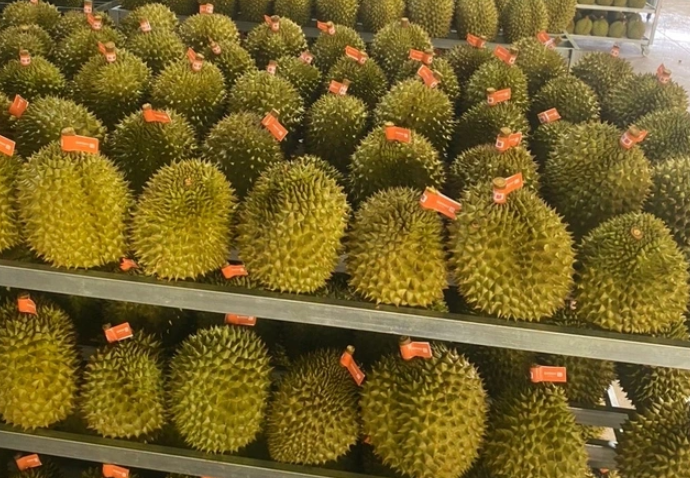
In the first half of the year, Vietnam exported nearly 130,000 tons of fresh durian, a significant decrease compared to the same period last year. However, the amount of frozen durian exported increased 3 times, reaching 14,282 tons.
Bright spot of frozen durian export
In the first months of the year, durian exports faced difficulties when some import markets tightened control over food safety, especially pesticide residues exceeding the permitted level, heavy metal contamination and banned chemicals.
Responding at the regular press conference of the second quarter of the Ministry of Agriculture and Environment on July 3, Mr. Do Hong Khanh, Chief of Office of the Plant Protection Department (Ministry of Agriculture and Environment), said that in the first half of the year, Vietnam exported 5,217 batches of fresh durian with an output of nearly 130,000 tons, a significant decrease compared to the same period last year.
However, frozen durian exports increased 3 times with 388 batches, equivalent to an output of 14,282 tons.
“Partly thanks to the market opening policy (signing the Protocol on exporting frozen durian to China in August 2024); at the same time, promoting deep processing, diversifying products, reducing dependence on the fresh durian market”, Mr. Khanh explained.
Recently, the Ministry of Agriculture and Environment has actively negotiated at high level to remove technical barriers of the import market.
Immediately after the General Administration of Customs of China (GACC) applied strict control measures on durian, the Ministry of Agriculture and Environment established a working group led by Minister Do Duc Duy to Beijing (China) to work directly with GACC in May.
The negotiation results helped restore 829 growing area codes and 131 packing facilities, contributing to improving durian exports from May.
In addition, the Ministry of Agriculture and Environment also invited GACC experts to conduct a field inspection of Vietnam’s export chain (expected from July 12 to 17).
Referring to the ministry’s request for testing laboratories to increase their cadmium and yellow O testing capacity, Mr. Khanh informed that, to date, there have been 24 cadmium testing laboratories and 14 yellow O testing laboratories approved by GACC.
Notably, in order to strengthen the management of growing area codes and packaging facilities, the Department of Crop Production and the Department of Plant Protection have digitized all data on growing area codes and packaging facilities, and operated a nationwide traceability system.
As of June, 1,396 growing area codes and 188 durian packaging facilities have been granted codes, qualified to export to China.
With the development of a Quality Control Process at durian packaging facilities for export, according to Mr. Khanh, the ministry is currently seeking the second opinion of relevant parties on the draft.
Fresh durian exports recover strongly since August
With China approving nearly 1,000 more codes for growing areas and packing facilities, along with positive signals from a number of import markets, the Plant Protection Department forecasts that fresh durian exports are likely to recover from the third quarter, especially during the main crop season from August to October.
“However, the recovery rate still depends largely on whether businesses and farmers can maintain food safety conditions as committed. If violations continue to recur, the export risk for this industry is still very high,” Mr. Khanh emphasized.
The potential for frozen durian exports is seen as continuing to be a bright spot in the coming time thanks to its stability and long-term preservation ability. Currently, many businesses are ready to invest in modern processing lines and cold storage, meeting the standards of China and potential markets such as Korea, Japan, EU…
In terms of export value, according to the General Secretary of the Vietnam Fruit and Vegetable Association Dang Phuc Nguyen, in the first 5 months of the year, durian exports only reached 387 million USD, down 58% compared to the same period in 2024. Of which, exports to the Chinese market decreased by 67.5%, reaching only 278 million USD.
Source: https://thanhnien.vn/xuat-khau-sau-rieng-dong-lanh-tang-3-lan-18525070309340043.htm